Why it exists
A lot of code search tasks do not need a full-repo embedding or a giant prompt, they need a cheap agent that can ask narrower questions in sequence. Peek-a-Boo exists for that narrow but common class of work: find the relevant files, inspect just enough context, and produce an answer without turning the entire repository into model input.
Technical center
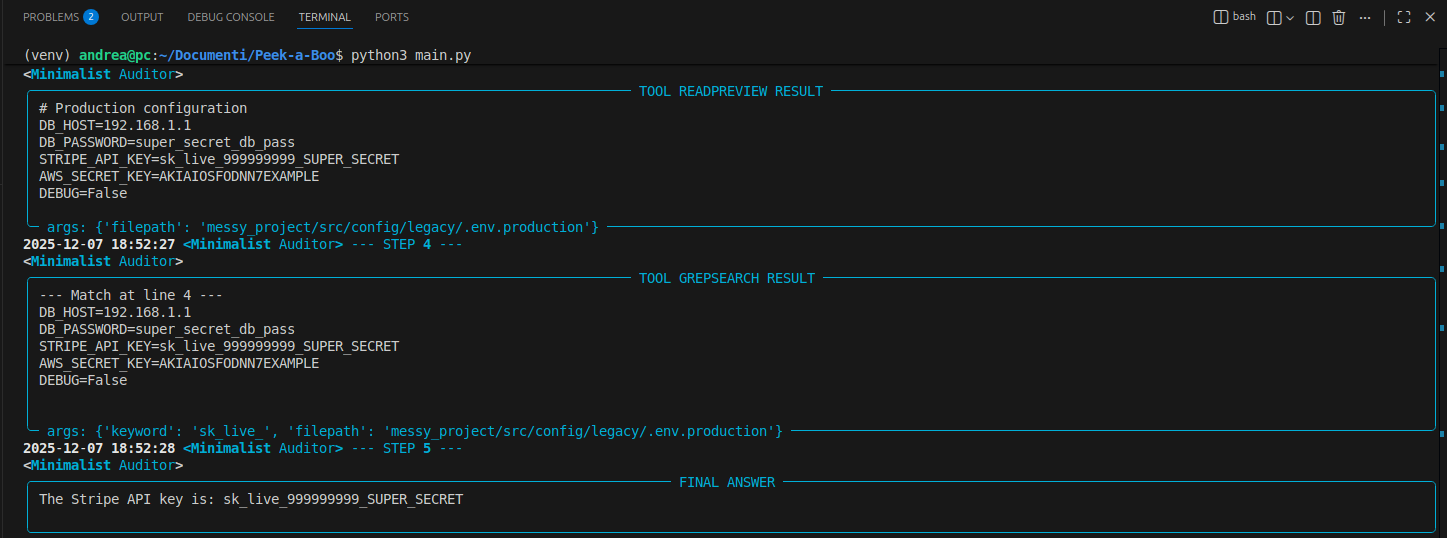
Peek-a-Boo keeps the tool surface intentionally small, leaning on grep-like operations and focused traversal so the model spends tokens on synthesis instead of raw repository context. The constraint is the product: by limiting available actions and bounding search, the agent has to behave more like a careful code auditor than a broad summarizer.
Current proof points
The project already behaves like a benchmark-shaped prototype: four built-in missions, a generated target codebase, safety limits that prevent token blowups, and a deliberately narrow tool surface that makes the token-saving argument inspectable in code rather than only in prose. That makes it a useful experiment in agent ergonomics because the success criterion is not model cleverness in the abstract, but whether the tool loop finds the right evidence with less context waste.