In the previous post on dlt + dbt I had landed
on a shape I liked precisely because it was so unspectacular: dlt wrote raw tables, dbt built on
top, and the contract between the two was not an always-on service but a Unity Catalog schema.
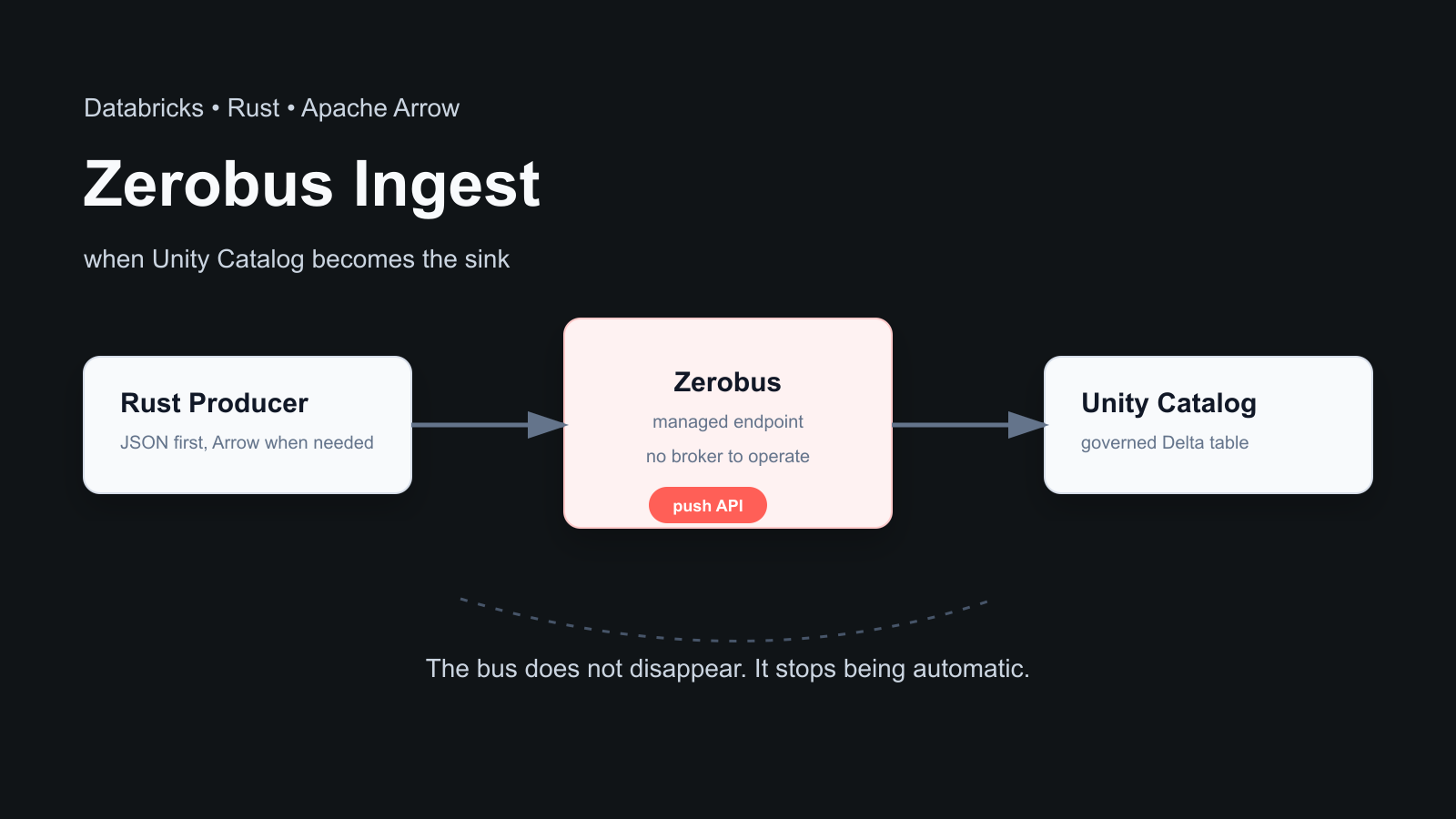
This post starts from the same exposed nerve, just closer to the edge of the system. If the sink is already known, governed and transactional — that is, a Delta table in Unity Catalog — how much infrastructure still needs to sit between it and the producer?
The short answer is that the bus does not magically disappear. It changes jobs. And in some cases its job is no longer being Kafka.

The Kafka reflex
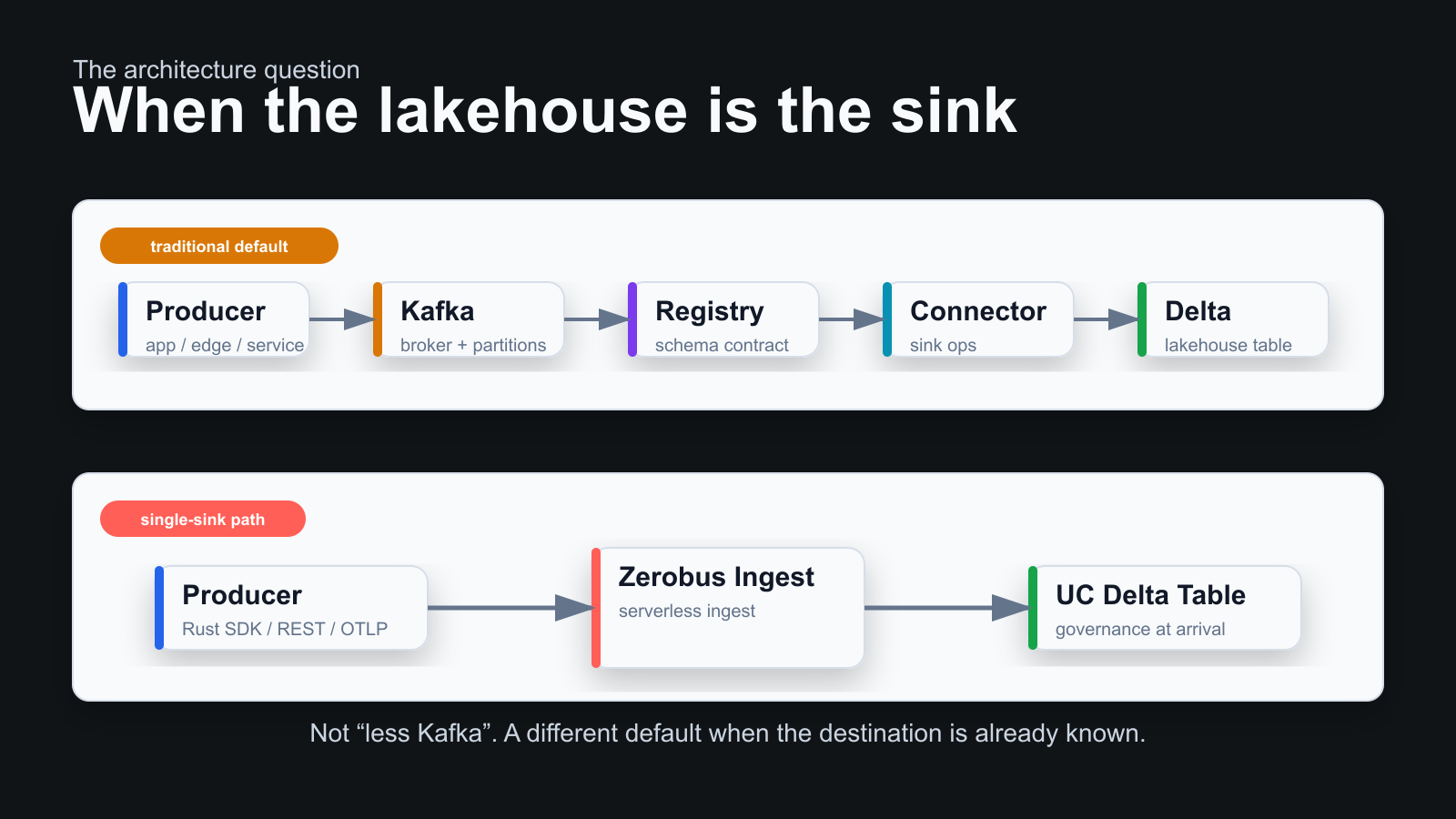
For years the mental default for streaming has been: producer, topic, partitions, registry, consumer groups, connectors, sink. And it often makes sense. If you have fan-out, replay, independent consumers, retention semantics, backfill and different teams reading the same event on different timelines, Kafka or something like it is not a detail: it is the product.
But there is a much narrower and very common class of workloads: sensors, collectors, gateways or application services that only need to push fresh events into a lakehouse table. They are not publishing a multi-consumer event domain. They are feeding a governed analytical sink.
Zerobus Ingest sits exactly in that space: a serverless push API that writes directly into Unity Catalog Delta tables. The part that interests me is not “fewer components” in the abstract. It is more precise: when the producer already knows that the contract is the table, Unity Catalog stops being just the place where data lands and becomes part of the ingestion protocol.
This is the connection with my recent posts:
- in the dlt+dbt post, Unity Catalog was the boundary between ingestion and transformation;
- in the posts on Arrow, DataFusion and tabular pipelines, the point was not losing columnar structure the moment data becomes interesting;
- in the Rust posts, from Lakekeeper to Zero Grappler, the recurring theme was using Rust where the boundary is tight: network, memory, schema, back-pressure.
Zerobus puts all three into the same small experiment.
What actually changes
The Databricks documentation describes Zerobus as a service that opens direct streams towards a target table: the client builds messages compatible with the table schema, the service makes them durable, acks the client, and then materializes them into Delta.
The important phrase is “compatible with the table schema”. Zerobus does not create the table for you, does not decide the contract and does not do automatic schema evolution. The table is the authority.
This shifts responsibility in a clean way:
- The producer does not send generic messages. It sends records for a specific table.
- Unity Catalog is not a passive catalog. It is the point where authorization, schema and storage meet.
- A stream is not a topic. A stream writes to one table; ordering is guaranteed per stream, not if you round-robin messages across different streams.
In my case I used the Rust SDK
with the arrow-flight feature enabled:
| |
I did the first pass with JSON, to validate credentials, endpoint and permissions without adding
Arrow friction right away. Then I did the real pass with RecordBatch and Arrow Flight.
The part that bit me: default storage
The demo was supposed to be trivial: create a managed Delta table in the workspace, grant
USE CATALOG, USE SCHEMA, MODIFY and SELECT to the service principal, then launch the
producer.
The first useful error was this:
| |
This is the kind of error that is worth a post. The table was managed. It was Delta. It was in Unity Catalog. But it was not in the kind of storage Zerobus accepts.
The limitation is explicit on the official
Zerobus Ingest limits page: it only
writes to managed Delta tables, but not on default storage. So I created a catalog dedicated to the
demo, zerobus_demo, with an S3 managed location registered through a storage credential and an
external location. The Unity Catalog documentation on
managed storage locations
explains the point: for a standard catalog, the MANAGED LOCATION has to live inside an external
location.
The final sequence was: a dedicated S3 bucket in us-east-2 (same region as the workspace, another
Zerobus requirement), a storage credential with an IAM role, the zerobus_demo_location external
location, the zerobus_demo catalog created with that MANAGED LOCATION, an events schema, then
the managed Delta table.
| |
I gave the demo service principal only the privileges it needed: USE CATALOG on the catalog,
USE SCHEMA on the schema and SELECT, MODIFY on the target table. Today
databricks grants get table on the table shows exactly those two privileges on the principal,
nothing else. The OAuth secret stayed in a local .env outside the repo.
One operational detail that cost me a few minutes: the external location had file events enabled by
default. This demo did not need them, and validation also asked for SNS/SQS permissions on top of S3.
I disabled file events on the location, and validation then passed on READ, LIST, WRITE and
DELETE.
| |
At that point the same managed table became acceptable to Zerobus.
The Rust producer
The producer is deliberately small: it reads the endpoint, workspace URL, table and OAuth client
credentials from .env, generates 64 synthetic telemetry events and pushes them into the table. A
single variable, ZEROBUS_FORMAT, picks the path: JSON or Arrow Flight. The full code, with the
table DDL and the minimal grants, is at
github.com/AndreaBozzo/zerobus-rust-demo.
The JSON path is the one to use when you want to remove variables. It sends the 64 records one at a time on the same stream, keeps the last offset and waits for the ack only at the end:
| |
The terminal, after the catalog fix, finally said the boring thing I wanted:
| |
Then I changed only the format:
| |
And the second pass landed in the same table:
| |
The verification query on the SQL warehouse:
| |
Result:
| source | rows | first_sequence | last_sequence | batches |
|---|---|---|---|---|
rust-sdk-arrow-flight | 64 | 0 | 63 | 1 |
rust-sdk-json | 64 | 0 | 63 | 1 |
The receipt in the Delta log
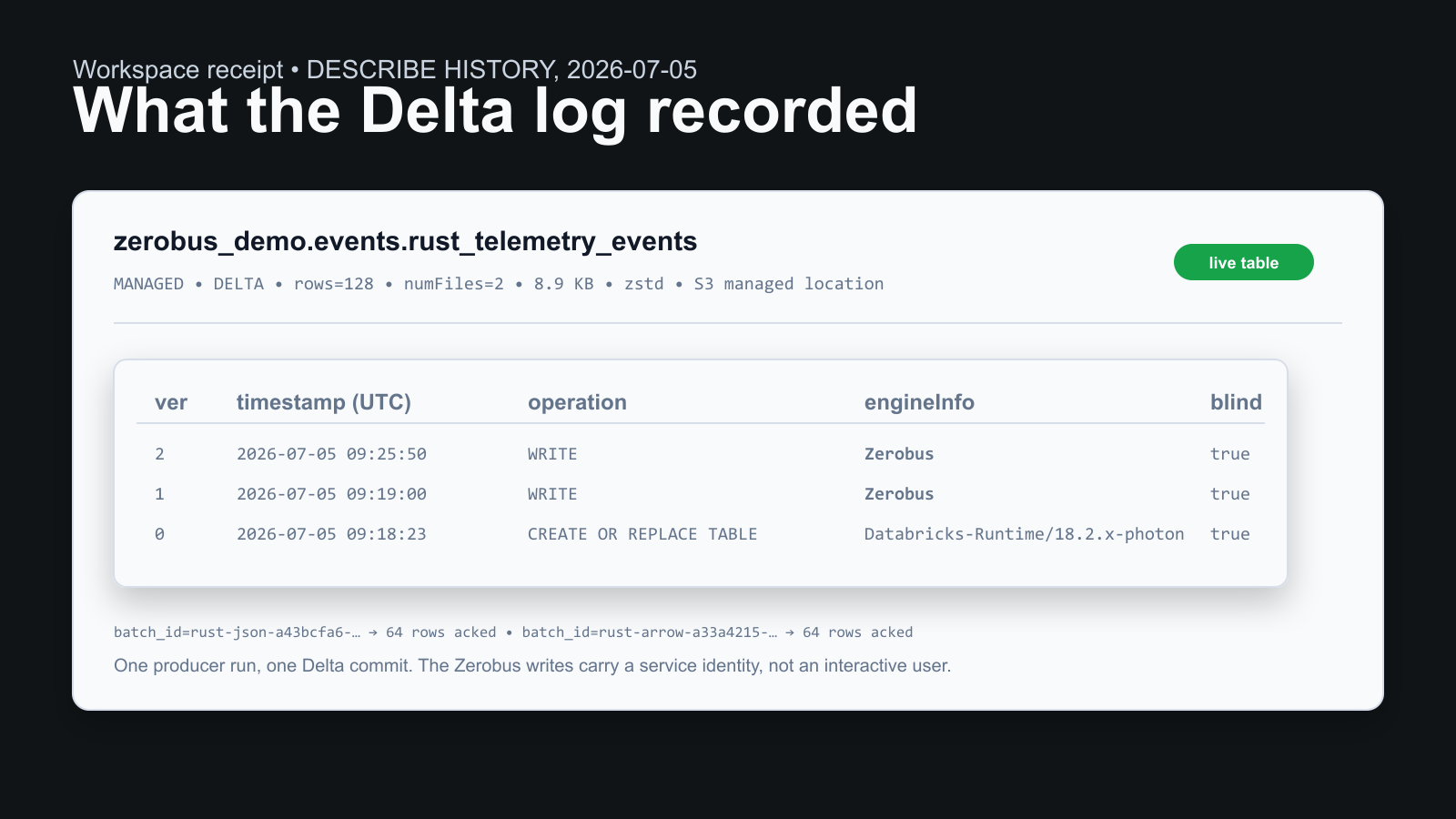
The verification I liked most, though, is not the SELECT. It is DESCRIBE HISTORY, because it
shows what Zerobus looks like from the table’s point of view:
| version | timestamp (UTC) | operation | engineInfo | isBlindAppend |
|---|---|---|---|---|
| 2 | 2026-07-05 09:25:50 | WRITE | Zerobus | true |
| 1 | 2026-07-05 09:19:00 | WRITE | Zerobus | true |
| 0 | 2026-07-05 09:18:23 | CREATE OR REPLACE TABLE | Databricks-Runtime/18.2.x-…-photon | true |
Three commits. The first one is mine, from the SQL warehouse, and indeed it carries my user and the
runtime’s engine. The other two are the producer’s two passes, and they arrive with
engineInfo=Zerobus, no interactive user, as blind appends. Each producer run is exactly one Delta
commit: no scattered micro-batches, no orphan files to compact right away.
DESCRIBE DETAIL closes the loop on the AWS side:
| |
The whole demo, on the bucket, is two zstd Parquet files totalling 8.9 KB. Volume was never the point: the point is that the data sits in the dedicated catalog’s S3 managed location, one file per commit, and it got there without the producer knowing anything about buckets, paths or AWS credentials.
One detail that makes “governed” concrete: I tried to LIST the table’s S3 path directly from the
warehouse, as the catalog owner. Refused:
| |
Unity Catalog does not let you go around the table to look at the managed location’s files, not even if you are the one who registered that location. Access goes through the contract, on write and on read. That is exactly the property Zerobus leans on.
Why Arrow Flight is interesting here
The documentation on
Arrow Flight with Zerobus Ingest
positions it as the third option next to JSON and Protobuf: you send Arrow RecordBatches directly
to the same endpoint, with DoPut over gRPC.
In my demo the performance advantage is not the point: 64 rows measure nothing. The point is the
mental interface. If you are already aggregating data in columnar form, or you come from Polars,
DataFusion, pyarrow or arrow-rs, you do not have to fall back to row-by-row JSON just to get into
the lakehouse.
The Arrow path in the producer looks like this: same endpoint, same OAuth, but the stream is built
around an Arrow schema and the 64 events leave as a single RecordBatch:
| |
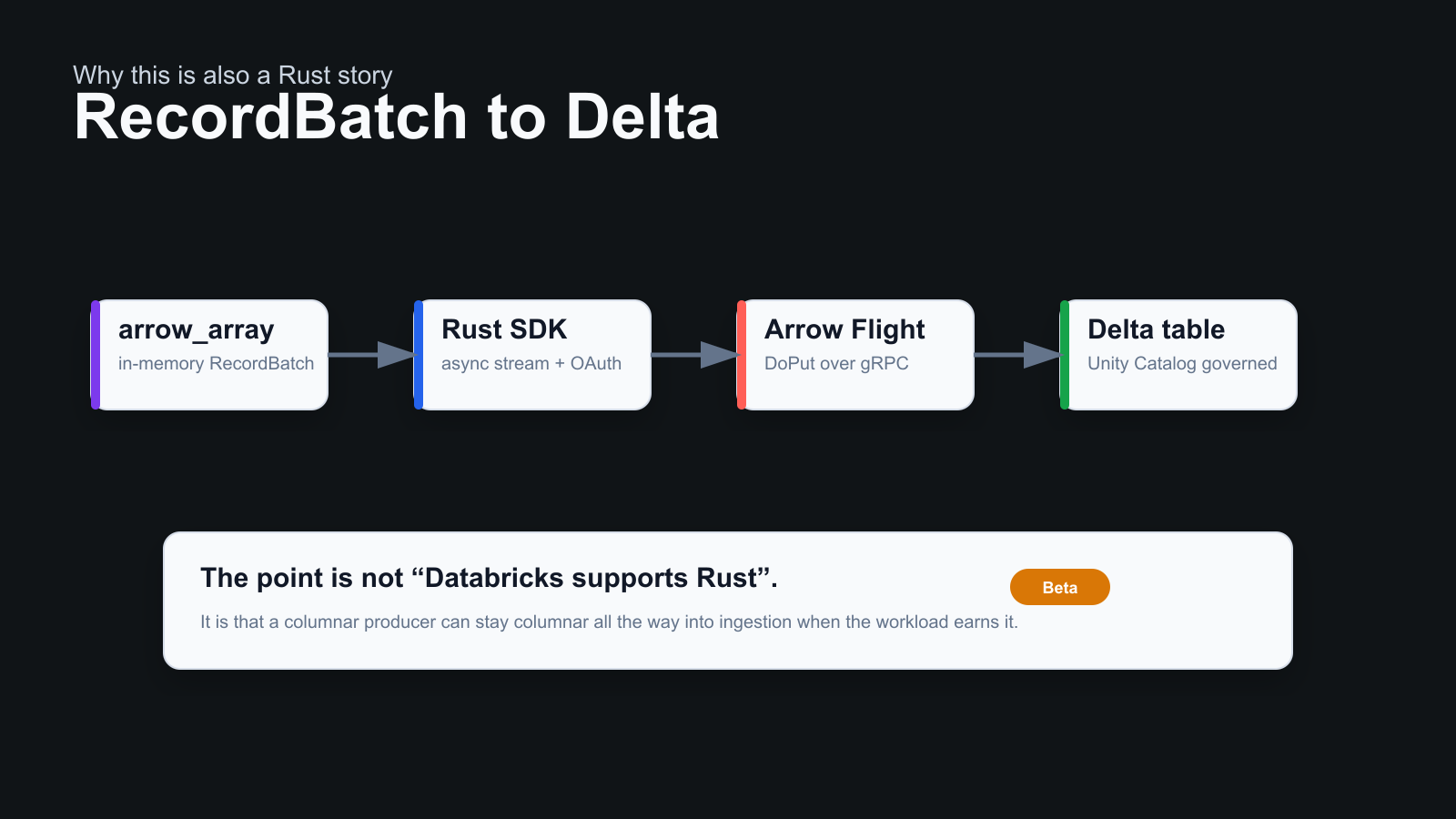
I like it for the same reason I keep coming back to Arrow in posts about data systems: it is not a “storage” format, and it is not just a library. It is a data plane. If a producer is born columnar, keeping that shape all the way to the ingestion boundary reduces copies, conversions and the points where the contract becomes implicit.
That said, Arrow Flight in Zerobus is still in beta. For simple, sparse, one-row-at-a-time traffic, JSON or Protobuf remain more direct. Arrow becomes interesting when the batch is natural.
The limitations to put before the demo
It is easy to sell yourself too clean a story here: “no Kafka, just an SDK, done”. That is not the right criterion.
These are the limits I would keep in front of the decision:
- At-least-once delivery. The producer needs an idempotency key or a dedup strategy if
duplicates matter. In my schema
event_idexists for this. - Ordering per stream. Ordering is guaranteed within a stream; if you raise throughput by opening more streams and round-robin across them, you no longer have global ordering.
- No auto-evolution. Zerobus does not evolve the table. Adding nullable columns is manageable (missing fields become NULL), but schema and producer have to stay coordinated.
- Managed Delta, not default storage. This is the point I verified in the real workspace: a managed table in default storage is not enough.
- Record size and quotas matter. The per-record limit is 10 MB, and it also applies to every
single row inside an Arrow
RecordBatch. The documented quotas are 100 MB/s and 15,000 records/s per stream, 10 GB/s per target table; workspace and table must be in the same region. - The buffer is not retention. Data that has been accepted but not yet materialized lives at most 31 days in the service. It is not a log you re-read from: it is a delivery queue.
- It is not an event bus. If you need long replays, multi-team fan-out, independent consumers or retention as a product, you are still talking to Kafka, Kinesis, NATS, Pulsar or similar.
The criterion I would use is simple: if the event has a life of its own, use a bus. If the event exists to land in a governed table and the rest of the platform reads from there, Zerobus deserves a try.
What I take away
The most instructive part was not writing the producer. That was pleasantly small. The interesting part was the initial failure on default storage, because it forced me to make the demo’s real boundary explicit: storage credential, external location, managed location, catalog. All the AWS plumbing that usually stays implicit became part of the contract.
In the dlt+dbt post the boundary was “a Unity Catalog schema between two tools”. Here the boundary is even earlier: the producer enters the governed world right away. It does not send a message to a neutral place hoping a connector will interpret it later; it opens a stream towards a table with a name, a schema, permissions and storage. And the Delta log records it like any other writer, with its own identity.
This does not make Zerobus a universal answer. But it sharpens a question that matters outside Databricks too:
when the lakehouse is the real sink, do I actually want to keep a general-purpose bus, or do I want to move the contract to the producer edge?
For a platform with many consumers, the answer is still a bus. For a single-sink, governed, high-volume pipeline, this demo convinced me it is worth having a second option.