That test is marked #[ignore] in my repository. Not because it is flaky, and not because I
gave up on it. The attached reason says it fails, that this is the experiment’s result rather
than a bug in the test, and how to reproduce it. It is the only honest place I had to put the
result the experiment was built to find.
The question it answers is narrow, and I wrote it down before I started so I could not move it later:
Can Delta and Iceberg both support idempotent
(app_id, epoch)commit, with the same abstraction, without an external transactional coordinator?
The answer is no. Here is how the answer got that specific, and why the “no” is more useful than the “yes” would have been.
The idea I was trying to kill
I maintain dataprof, a profiler. It reads data and
reports on it. It does not move data, and its AGENTS.md says so in one sentence, which
turns out to matter later.
Working on it long enough surfaces the same structural complaint from every direction: a profiler tells you the data is wrong after the data is durable. You get a beautiful report about a table that production is already reading. The check and the consequence live in different places, and the gap between them is measured in whatever your orchestration interval happens to be.
So the idea. Not a better check — a different position for it. An Arrow batch should not become durable production data unless its contract passes, and the proof that it passed should commit atomically with the data and with the source progress. Call it a quality-aware commit barrier.
I want to be careful here, because this is the point where a post like this usually starts
inventing a market. Ingestion systems that treat the commit seriously already exist, and some
of them are excellent at it. Estuary’s materialization protocol states the requirement
flatly: “Updates to the checkpoint and to the view state MUST always commit together, in the
exact same transaction.” It is equally frank about what happens when the endpoint cannot
participate — “Note that this pattern is at-least-once. A transaction may fail part-way
through and be restarted, causing its effects to be partially or fully replayed.” Databricks
does the quality half inside the pipeline, where an expectation can warn (“invalid records
are written to the target”), drop (“invalid records are dropped before data is written to
the target”), or fail (“invalid records prevent the update from succeeding; manual
intervention is required before reprocessing”).
None of that is missing. What I could not find was the portable version: a barrier that sits between an arbitrary producer and an arbitrary lakehouse sink and takes part in the decision to advance state, without owning the whole pipeline.
Every piece of that is either solved or cheap, except one. The commit has to be portable across storage protocols, or it is not a primitive at all — it is a feature of one table format wearing a trait as a disguise.
That single unknown is the whole experiment.
The setup, and the kill list
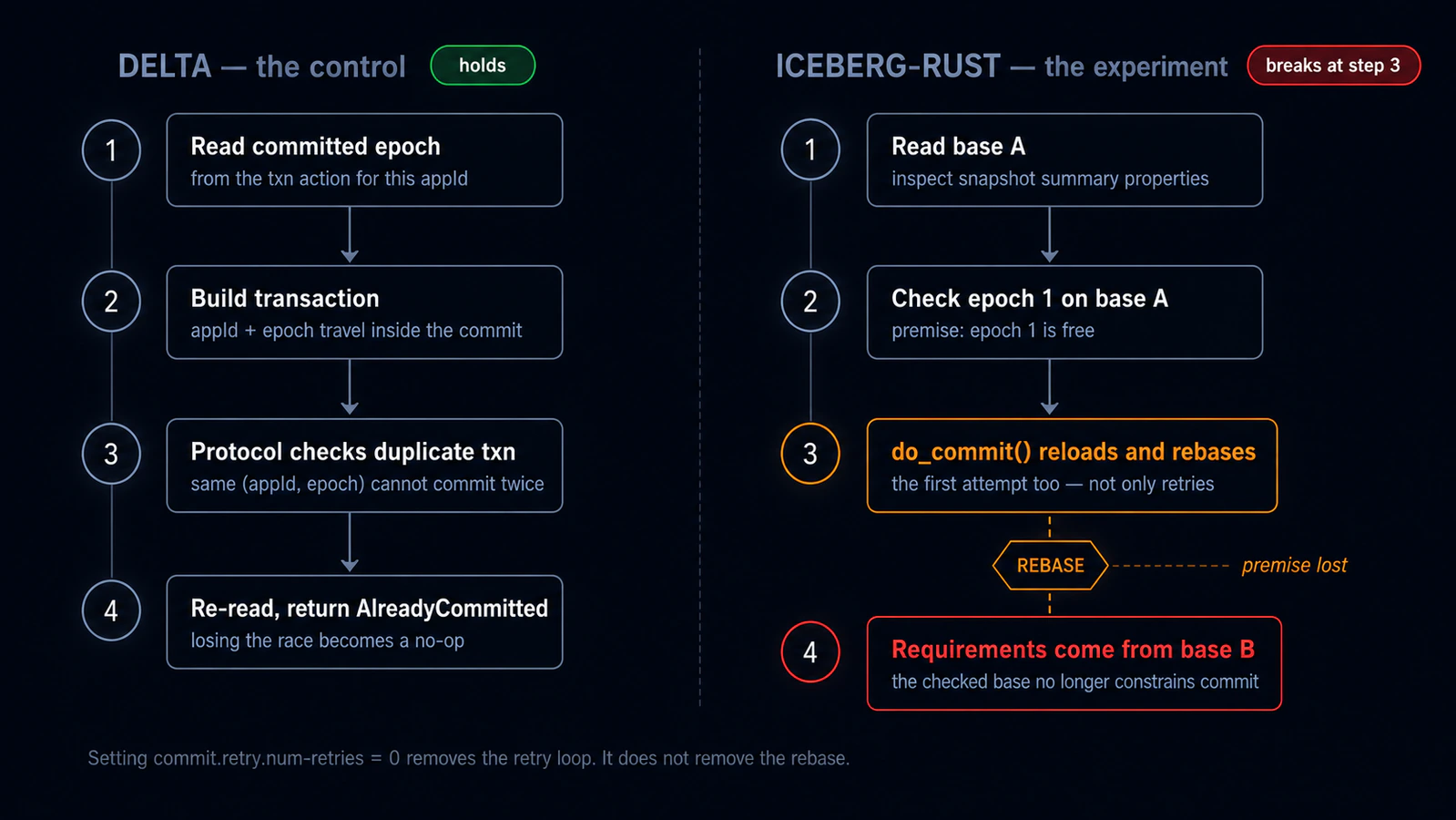
Delta is the control. Its protocol has a purpose-built transaction identifier action
carrying an appId (String) and a version (Long), for the express purpose of letting an
external application “avoid duplicating data in the face of failures and retries during a
write.” Implementing the barrier on Delta and declaring victory would be discovering a Delta
feature. It proves the harness works. It proves nothing about the idea.
Iceberg is the experiment. It commits by optimistically writing new metadata and
atomically swapping the table-metadata pointer, with conflict detection and retry. It has no
equivalent application-transaction mechanism. The candidate carrier for the epoch is a
snapshot summary property, and whether a check-then-commit can be folded into the retry loop
safely, using only what iceberg-rust exposes, was the unknown.
Then the part I recommend to anyone running an experiment they have an emotional stake in. Written before any code, in the README, four conditions under which I stop:
- Iceberg needs a destination-specific architecture rather than the same
CommitSinkimplementation shape as Delta. - Iceberg needs an external transactional store to make the epoch check atomic with the commit.
iceberg-rustcannot express the required commit at all today, and the gap is in the specification rather than in the implementation’s maturity. (An implementation gap is a different finding: it means “not yet”, not “no”.)- Making it work requires owning more than a trait’s worth of the write path.
The trait itself is deliberately the smallest thing that can carry the claim — committed_epoch,
commit, and a row count for the tests. If it had to grow a destination-specific method to
make Iceberg work, the experiment had already answered its own question.
Three findings from reading, before anything ran
Reading iceberg 0.10.1 before writing the sink was the highest-value hour of the project.
The epoch has somewhere to live. FastAppendAction::set_snapshot_properties puts
arbitrary keys into the snapshot summary and they read back through
snapshot.summary().additional_properties. Computed metric keys such as added-records win
over user-supplied ones, so a reserved key cannot be corrupted by a caller, and my key is not
reserved.
The commit path is exactly the right shape. Transaction::do_commit
(src/transaction/mod.rs:218) reloads the table from the catalog, discards a stale base,
re-applies the actions against the refreshed metadata, and submits a TableCommit carrying
TableRequirements that the catalog validates on the pointer swap.
TableRequirement::RefSnapshotIdMatch is a compare-and-swap pin. Refresh, re-check, CAS —
that is the loop an idempotent commit needs, already written.
And the door to it is locked. TransactionAction is pub(crate)
(src/transaction/action.rs:37). What the module exports is ApplyTransactionAction and
ActionCommit — enough to apply the actions the crate already defines, and not enough to
define one. No third party can write an action whose commit(&table) runs against the
refreshed table inside the loop.
That third finding is the entire post, and I did not understand it yet.
The claim I got wrong
An earlier version of my own README said deltalake and iceberg held arrow at 56 against
dataprof’s 59 — three majors of skew, an ugly structural argument against the whole idea.
It was wrong, and the error was mine. The 56 in the lockfile came from an arrow = "56" pin
in my crate’s Cargo.toml, not from either library. Both iceberg 0.10.1 and
deltalake-core 0.32.4 require arrow-array 58. dataprof is on 59.1.0. The real skew is one
major version, which is an ordinary Tuesday, not an obstacle.
I am including this because the argument I was making did not need it. A crate that writes Delta tables does not belong in the dataprof workspace, because dataprof profiles data and does not move it. That was always sufficient. The version claim was decoration, and decoration is exactly the kind of claim that turns out to be false.
The test that passed for the wrong reason
Here is the part I would most like other people to steal.
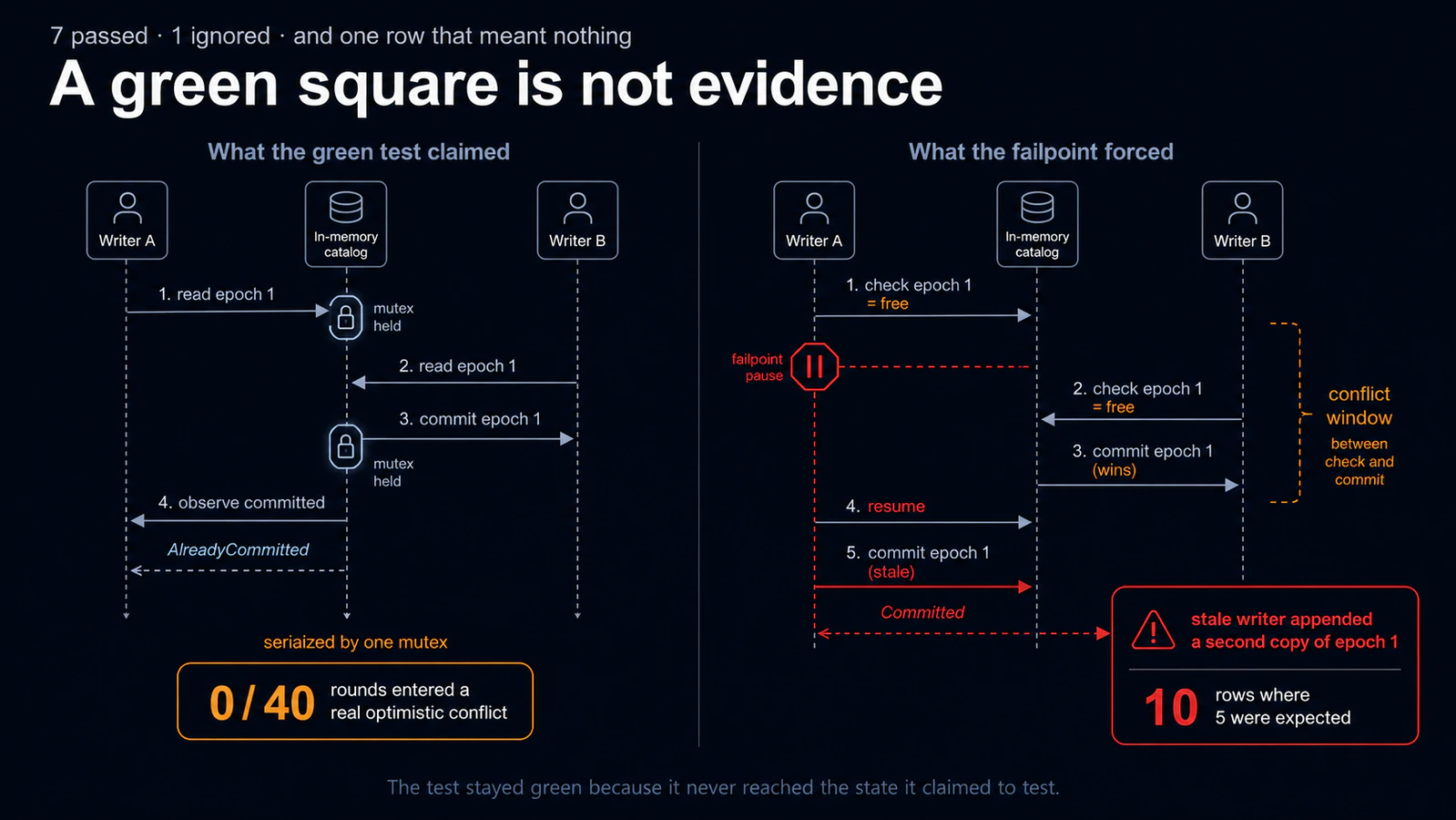
Three tests, one generic body each, parameterised over the sink: replay of a committed epoch writes nothing, distinct epochs accumulate, concurrent writers of one epoch commit once. Both sinks passed all three.
Green. And the concurrency row is a lie.
I had written a fourth test whose only job is to distrust the third: it runs the race forty times and counts how often the two writers actually contend, reporting the number instead of asserting on it, because a scheduler is allowed to serialize.
Zero. Not “rarely” — never. The in-process memory catalog takes one mutex for every
operation, so the loser’s read is already ordered after the winner’s commit, and it returns
AlreadyCommitted without ever reaching the window where a duplicate could be born. Forty
rounds of a concurrency test that never ran concurrently.
A test that has never been in the state it claims to test is not evidence. It is a green square. If I had shipped on the strength of that row I would have shipped a duplicate generator with a passing CI badge.
The failpoint, and the answer
If scheduling will not reach the window, hold the window open. One failpoint between the epoch check and the commit:
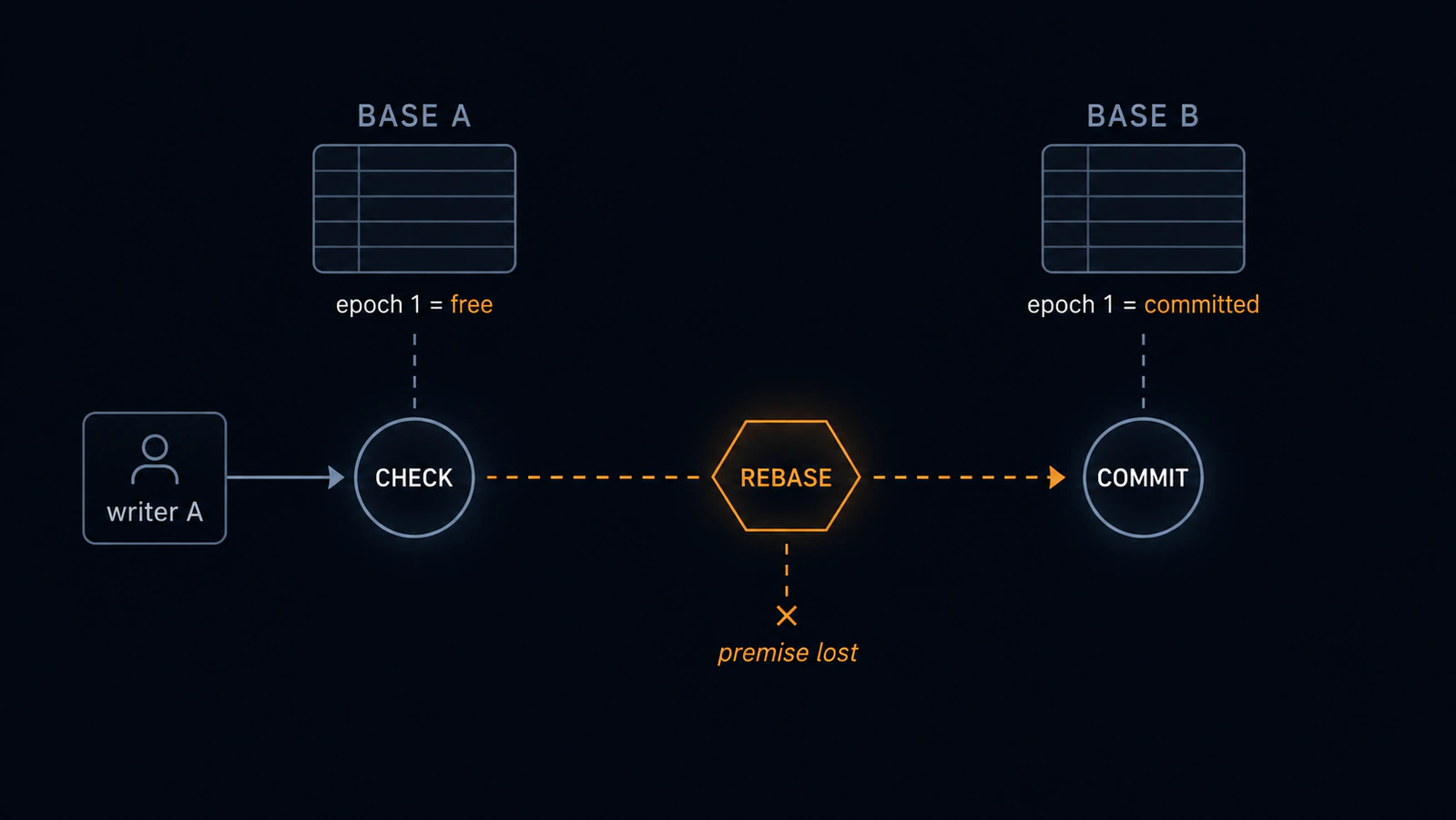
The epoch check cannot be enforced. A writer that checks while the epoch is free, and only then loses the race, commits a duplicate.
Why. do_commit reloads the table and rebases onto it before applying any action — on
the first attempt as well as on retries. The requirements the append emits are therefore
derived from the refreshed base, not from the base the caller inspected. The stale writer’s
fast_append is re-pointed at the winner’s snapshot and succeeds.
I had assumed the retry loop was the problem, so I had already set
commit.retry.num-retries = 0 and owned the loop myself. It does not help. It removes the
retry; the rebase is not part of the retry. The rebase is what discards the caller’s premise,
and it happens on the way in.
Both ways out are closed, and closed deliberately:
TransactionActionispub(crate), so the check cannot move inside the loop where it would see the refreshed table.TableCommitis a public struct whose builder’s build method ispub(crate)(#[builder(build_method(vis = "pub(crate)"))],src/catalog/mod.rs:350), so a caller cannot construct a commit carrying its ownTableRequirement::RefSnapshotIdMatch. The doc comment is explicit about why: “The builder is marked as private since it’s dangerous and error-prone to constructTableCommitdirectly. Users are supposed to useTransaction.”
Catalog::update_table(TableCommit) is public. Nothing outside the crate can build its
argument.
This is not a problem with Iceberg
I want to be precise about the blame, because the interesting version of this story is not “library bad”.
The Iceberg specification is fine. It has requirements and an atomic pointer swap, which is
everything the primitive needs. The reference implementation is fine too — better than fine,
it has the exact hook. SnapshotProducer.validate(TableMetadata currentMetadata, Snapshot snapshot)
is protected in the Java core, apply() calls it, and the commit loop calls apply() on
every retry attempt, so a Java operation re-validates against the refreshed base each time
around. BaseRowDelta, BaseRewriteFiles and StreamingDelete each override it. That is a
first-class extension point for exactly this.
iceberg-rust has the structurally identical hook: TransactionAction::commit(&Table),
invoked by do_commit against the refreshed table. The only difference is that Java’s is
subclassable and Rust’s is pub(crate).
And the closure is defended, which is the part worth arguing about rather than complaining
about. A library that owns its retry loop cannot hand out caller-chosen preconditions without
also handing out a footgun; the TableCommit doc comment says as much in plain language.
Owning the retry loop and supporting external preconditions are in genuine tension. Java
resolved it with protected — safe by default, reachable by subclass. Rust has no
protected, so the same design decision arrives as a much blunter choice, and the blunt
version currently rounds to “no”.
There is a third possibility I have to hold open: that the rebase is intended to be
unconditional and the guarantee I wanted was never on offer. If so the fix is a documentation
one — say that a Transaction carries no guarantee about the base it was built from, so
nobody else builds a precondition on it.
The verdict
Against my own kill list, this is Kill 1: as things stand, Iceberg would need a destination-specific architecture. It is Kill 3’s exemption in principle — an implementation gap, “not yet” rather than “no” — but the exemption only pays out if upstream changes, and until it does the abstraction is Delta-only. A Delta-only commit barrier is a delta-rs feature. Ruling that out is precisely what the experiment existed to do.
| Test | Delta | Iceberg |
|---|---|---|
| Replay of a committed epoch writes nothing | pass | pass |
| Distinct epochs accumulate | pass | pass |
| Concurrent writers of one epoch commit once | pass | pass, but never raced |
| Stale writer loses the CAS without duplicating | not run | FAIL |
The last row deserves its “not run”. Delta passes that case by construction — its conflict
checker rejects a second txn at the same (appId, version), and the sink converts the
rejection into AlreadyCommitted by re-reading — but I wrote the failpoint for Iceberg and
never built the Delta twin. It is an argument from the protocol, not a measurement, and I am
not going to dress it up as one.
The trait held. One CommitSink, one set of test bodies, two implementations, no
destination-specific method. The design was sound; the guarantee underneath it was not
available on the only sink that could decide the question.
What I am doing about it, and what I am not
I stripped the experiment down to a crate that depends on iceberg, tokio and tempfile —
no Arrow, no Parquet, no data files, because the bug is in how Transaction picks its base,
not in what the action writes — and published it as
iceberg-stale-base-repro. It runs
in one command:
The issue is apache/iceberg-rust#3134,
opened 2 September 2026, with two concrete directions — export TransactionAction, or allow
a caller-supplied TableRequirement on a Transaction — and an offer to write the PR for
either. As I publish this it is open with no replies. I am not going to pretend that is a
collaboration; it is a message in a bottle with a reproduction attached, which is the most I
can honestly claim.
What I am not doing is shipping this in dataprof. Not because it is too ambitious — because dataprof profiles data and does not move it, and a crate that writes Delta tables moves it. The quality half of the original idea is tracked where it belongs, as two open issues on dataprof: structured, prioritised findings on the report and a small batch quality-gate API. Open. Not shipped, not secretly finished. They lose nothing by the commit half not existing, which is the clearest signal that the two halves were always separable and I had bundled them out of enthusiasm.
So: I started out wanting quality to be a precondition of durability, and I ended up learning that on one of the two major Rust lakehouse clients, nothing can be a precondition of durability from the outside. Not quality — anything. The general problem is upstream of mine, and it is four lines of visibility wide. Changing those four lines is an afternoon. Deciding whether they should change is the actual work, and it is not mine to do.
The whole spike is nine commits on a single day. I would rather have found that out in a day than in six months of a framework.